Guide to Non-Government ID: Memdeklaro vs. Digitalcourage vs. World Passport
Guide to Non-Government ID: Memdeklaro vs. Digitalcourage vs. World Passport
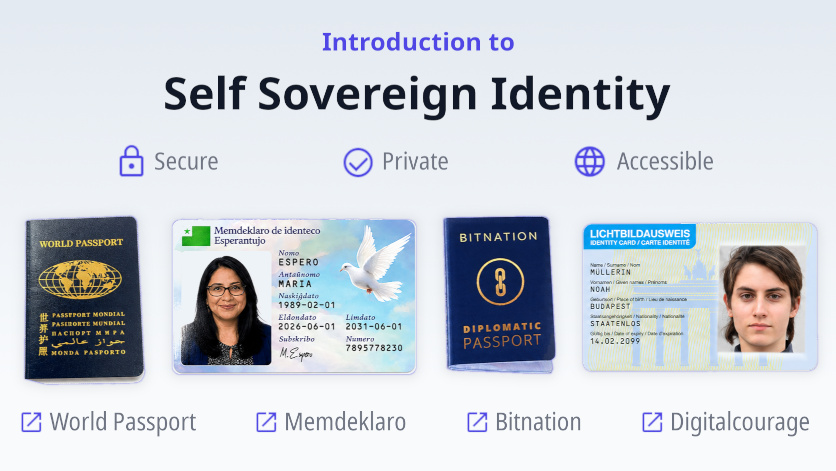
Non-government ID solutions can offer privacy, inclusion and freedom when centralized systems fail. This guide compares the Memdeklaro self-declaration, the Digitalcourage photo ID card and the World Citizen Passport.
By Memdeklaro | May 15, 2026
Introduction
An increasing number of services now require proof of identity, from employment, banking and education to housing, healthcare, contracts, SIM cards, mail collection and even visiting a library or joining a gym.
Yet these requirements can raise privacy concerns, create barriers to access, and exclude people from services they have used for years.
The Hidden Problem of ID Requirements
Government-issued identification is not universally accessible, although this is often overlooked. The problem extends beyond application fees, long waiting times, traveling to government offices, or the difficulty of locating old paperwork.
Millions of people worldwide cannot obtain government-issued identification at all. No government department or authority will issue them a birth certificate, national ID card or passport.
In most cases, this is not a consequence of criminal activity. Instead, it stems from a person's circumstances of birth or upbringing. They may be stateless, a refugee or a dissident, their parents may never have registered their birth, or they may have escaped severe abuse within their family or a cult.
It is often assumed that this is a minor bureaucratic problem, solved by a straightforward procedure to register the person and establish their legal identity, perhaps through delayed birth registration or a statelessness determination process.
In practice, accessing these procedures or obtaining the necessary documents can be difficult or impossible. This is not always because the individual has failed to act or cooperate. Governments may refuse to accept applications, reject them arbitrarily or discriminatorily without providing an effective appeals process, or lack any procedure in the first place.
Human rights organizations, including the United Nations, the Red Cross and Amnesty International, have documented the challenges associated with lack of government-issued identification. The cause is often institutional rather than personal. Nevertheless, individuals continue to bear the consequences, sometimes even being treated as criminals through no fault of their own.
Imagine being unable to find employment, rent an apartment or visit a doctor, purely because your parents never registered your birth. Or imagine being denied recognition as a citizen by your country of birth, while that same country also refuses to recognize you as stateless or issue you a non-citizen travel document to start a new life somewhere else. In many situations, there may be no way to appeal or seek an alternative.
The History of ID Requirements
Reputation: Good Enough for Most of Human History
For much of human history, trust was established through personal reputation and word of mouth. Passwords and keys provided authorization, while identity was often established through self-declaration: stating your name, completing a form or providing a signature.
Where additional assurance was necessary, people could rely on endorsements from trusted community members, cash deposits or escrow arrangements.
Local churches may have recorded births, deaths and marriages, and governments may have occasionally conducted a census. However, participation in everyday life did not require third party permission or a certificate signed by a king.
Hard work and a positive attitude could be enough to build a good life. Stories of underdogs overcoming adversity and achieving success were celebrated.
In this sense, the system was meritocratic and accessible: people were judged by their actions and efforts rather than by whether a centralized authority had granted them permission to participate in society.
The 20th Century: The Birth of Surveillance Technology
After the First World War, governments began introducing national identity cards and passports. Initially, these documents were generally used for international travel rather than serving as a requirement in everyday life.
However, government identification systems soon became instruments of control in authoritarian regimes. For people who could obtain identification, these systems enabled states to monitor and censor their citizens. For those who could not, it served as a means of exclusion from economic and social life.
Many people attempted to escape these regimes, only to encounter a devastating obstacle: other countries refused to admit them without identity documents, presumably issued by the very regimes they were fleeing.
When authoritarian governments used identity as a means of control and exclusion, defectors, dissidents and refugees frequently found themselves without government-issued proof of identity. Their own declarations were not accepted as an alternative.
As a result, innocent people were left stranded at sea because no country would admit them, or sent back to the regimes they had escaped, where they faced imprisonment or death. They were denied the chance to begin a new life in safety, simply because they lacked a piece of paper.
Nansen Passports: An Alternative to Government ID
Fridtjof Nansen was shocked by this cruelty. Peaceful people who wanted to work and contribute to society were being abandoned, purely because they lacked documentation. Working with the League of Nations, he developed a travel document known as a laissez-passer, later named the Nansen Passport in his honor.
The Nansen Passport provided an identity document that did not depend on issuance by a nation-state. It was available to anyone who needed it, including people fleeing authoritarian governments which refused to issue them passports.
The initiative worked. Hundreds of thousands of people used Nansen Passports to find safety in the United States, the United Kingdom and Western Europe.
Border officials, who had previously refused entry, were happy to grant Nansen Passport holders work visas and residence permits. People could then begin rebuilding their lives in safety. The document was a simple paper booklet, but for many, it made the difference between life and death.
The End of Nansen Passports: The End of Universal Access to Identity
The Nansen Passport was discontinued in the 1940s as international conventions concerning statelessness and refugees took its place. Responsibility for issuing identity documents returned to nation-states, returning to the problem that the Nansen Passport had solved.
In practice, these conventions did not guarantee access to legal identity for everyone. From the 1940s to the present day, nation-states have continued to refuse birth certificates, national identity cards and passports to millions of people, sometimes without a right of appeal or any alternative route to documentation.
The Nansen Passport had served as an issuer of last resort: a genuine option for people whom no other authority would help. Once it disappeared, no equivalent alternative took its place.
Garry Davis and the World Passport
In 1953, peace activist Garry Davis founded the World Service Authority, an organization intended to encourage cooperation and understanding among people worldwide.
He started the World Citizen movement, which rejected discrimination based on birthplace or birth culture and instead emphasized the shared identity of humanity.
Less than a decade after the horrors of the Second World War, amid the political tensions of the Cold War, Davis dedicated his life to the goal of world peace.
For this goal, the World Service Authority launched the World Passport. These documents were intended to support freedom of movement, provide accessible identification for refugees and stateless people, and advance the idea of world citizenship.
After renouncing United States citizenship, Davis traveled using a World Passport. The document received varying degrees of recognition, both de jure and de facto, from multiple countries around the world.
From 1953 to 2026, more than one million World Passports have been issued. Applications can be submitted online or by mail, and the World Service Authority has also distributed passports free of charge to refugees and stateless people over the years.
The application process is designed to accommodate people who lack formal identification. Although applicants may submit a copy of an existing government-issued ID if they have one, fingerprints can be provided as an alternative.
This approach helps break the vicious circle in which a person must already possess identification to obtain their first identity document, even when no nation-state is willing to issue one.
While countries including Ecuador, Mauritania, Tanzania and Zambia formally recognized the World Passport during the 20th century, it is unfortunately not widely accepted by authorities today as a sole identity document. Authorities such as the European Union currently classify it as a fantasy passport.
Nevertheless, the World Passport remains distinctive for its humanitarian mission, its case-by-case acceptance, and its accessibility for applicants without existing identity documents. It continues to represent a modern approach to non-government identification.
Micronations: An Extension of the System, Not an Escape
In recent decades, multiple micronation projects have launched. Some seek to claim unclaimed land, establish sovereign nations on private property, or build seasteads in international waters.
Micronations can offer an appealing alternative to the restrictions imposed by modern nation-states. They may introduce competition in business, finance, law and governance, while fostering open-minded, meritocratic communities that could offer refuge to people escaping authoritarianism.
Some have gained recognition from nation-states or other institutions. Two prominent examples are Liberland, founded by Vit Jedlicka in 2015, and Prospera, founded by Erick Brimen in 2021.
However, formal recognition comes with risks. It can undermine a micronation's independence by making it subject to the regulations of established nation-states. In this way, new possibilities for self-governance can become co-opted into the very structures they sought to transcend.
A pertinent example is that both Prospera and Liberland now require existing government-issued identification for residency applications or, in Liberland's case, citizenship applications.
Micronations could have offered hope to people excluded from existing systems. If applicants could apply for residency or citizenship without a national passport, perhaps through an interview, vouches from trusted individuals or fingerprints as an alternative, they might gain a genuine opportunity to escape difficult circumstances, join a community, work and contribute to society.
In reality, micronations that impose government ID requirements reproduce many of the same barriers as nation-states. If no country will issue someone a passport or birth certificate, micronations may be unable to serve as a refuge, whether for physical residency or as a first citizenship.
Bitnation: Blockchain Identity for All
Bitnation was an ambitious blockchain-based project founded by Susanne Tarkowski Tempelhof in 2014.
It provided a framework for virtual micronations built around freedom of association, intentional communities and voluntary relationships. Its broader vision of a Network State aimed to empower individual freedom worldwide.
Bitnation explicitly supported communities of choice, emphasizing that personal beliefs and actions should matter more than the circumstances of a person's birth. Its philosophy held that everyone should have the opportunity to build a good life within a community of their choosing, rather than remain permanently confined to the culture into which they were born.
The project offered a framework for voluntary communities, governance, contracts, finances and identity. One of its major achievements was the Bitnation Diplomatic Passport, a physical passport booklet available to anyone regardless of nationality or status.
Applying for a Bitnation Diplomatic Passport required only payment of a fee and an interview with a Bitnation ambassador. An existing government-issued ID was not necessary, making the document accessible as an foundational form of identity documentation. Bitnation also distributed identity documents free of charge to refugees and stateless people.
Unfortunately, Bitnation ceased operations in the early 2020s.
Nevertheless, it left a mark on the world as a pioneer in blockchain identity and voluntary communities. Perhaps a future blockchain project will carry its vision forward and continue its work toward a freer world.
Digitalcourage Lichtbildausweis: A Modern Solution
Digitalcourage was founded in 1987 by Rena Tangens and padeluun to advocate for human rights, particularly the fundamental right to privacy.
Over the years, the organization has challenged privacy-invasive practices by corporations and legislators while educating people about protecting their privacy, resisting surveillance and living freely.
As more companies began demanding proof of identity, including for services they had provided successfully for decades without it, the Digitalcourage team recognized the implications for privacy and surveillance and began developing an alternative.
The situation was troubling. Services that people had used for years suddenly became inaccessible, not because of poor conduct, but because of an insurmountable bureaucratic barrier. Access to essential services was withdrawn without an alternative. People were caught in a vicious circle: ID was required to access services, yet no authority was willing to issue an ID.
In 2013, Digitalcourage introduced a solution: the Digitalcourage ID, a photo ID card resembling a conventional ID card and displaying a photograph, name, date of birth and other personal details. It is presented as a non-government identity document for situations in which the law does not require government-issued identification.
The card is available to everyone, and applicants do not need an existing government-issued ID. The non-profit explicitly permits the use of a self-chosen name and allows stateless people to apply.
Unlike a passport, the Digitalcourage ID is not intended for international travel. Its purpose focuses on everyday activities in which a business or organization may ask for proof of identity, such as collecting mail, renting an apartment, joining a library or using a gym.
Digitalcourage deliberately distinguishes between situations in which government-issued identification may be legally required, such as crossing a border or opening a bank account, and those in which the law does not require it but a company's own policy stipulates customer identification. The latter may include post office boxes, rental agreements, memberships and personalized tickets.
Acceptance by private companies is not guaranteed. Nevertheless, anecdotal reports suggest that some people have successfully used the Digitalcourage ID in everyday situations.
Ideally, services would return to operating without identification requirements where unnecessary. Until then, non-government identity documents can help people to regain access to society and continue using the services they need. The Digitalcourage ID offers a valuable alternative to the state monopoly on identity.
Memdeklaro: Ethical Self-Declaration of Identity
The Memdeklaro project began in November 2024 as a public domain initiative.
Its central concept is Memdeklaro de identeco — a self-declaration of identity that can take the form of a plastic card, business card or digital ID.
The unique part of Memdeklaro is that individuals create and print their own declarations. There is no central issuer, centralized registry or third-party intermediary.
Following the philosophy of freedom of identity, Memdeklaro supports people's ability to choose their own names, culture and personal ties, rather than be confined by the circumstances of their birth. The card deliberately excludes birthplace, citizenship or stateless status, and the names of birth parents. An optional notes field allows holders to express personal beliefs, such as conscientious objection.
Anyone can generate a self-declaration free of charge through the Memdeklaro web app. Privacy is built into its design: the application runs locally on the user's device, and personal data is never transmitted to a server nor stored in a database. Once generated, the declaration can be printed as a plastic card or business card, or used in digital form.
The project's public domain dedication allows anyone to fork the software and develop alternative designs, implementations and related projects.
Memdeklaro is still relatively new. Hopefully, self-declaration of identity will gain wider awareness and become a familiar alternative over time.
What Solutions Exist Today
The World Passport, Digitalcourage photo ID and Memdeklaro self-declaration remain practical non-government ID options available today.
All three are worthwhile approaches. They do not require applicants to possess an existing government-issued ID, all allow stateless applicants, and all pursue humanitarian goals. Their differences lie in their formats — passport booklet versus physical or digital ID card — their designs, the personal information they contain, and practical details such as cost, processing time and application process.
The following table summarizes the main differences.
Comparison Table
| Feature | Memdeklaro | Digitalcourage Lichtbildausweis | World Passport | Bitnation Diplomatic Passport |
|---|---|---|---|---|
| Basic concept | Self-declaration of identity | Privacy-friendly ID | World citizenship passport | Blockchain ID |
| Year of launch | 2024 | 2013 | 1954 | 2018 |
| Issuer | Self-asserted | Digitalcourage e.V. | World Service Authority | Bitnation |
| Cost | Free | €15 | $75 | $149 |
| Processing time | Instant | 10 days | 4 months | Discontinued |
| Format | Physical or digital ID card | Physical ID card | Passport booklet | Passport booklet |
| Data included | First name, last name, photo, birth date, signature, notes field | First name, last name, photo, birth date, birth place, citizenship or stateless status, eye color, height, home address, pseudonym | First name, last name, photo, birth date, birth place | Unknown |
| Data excluded | Birth place, citizenship or stateless status, parents' names | N/A | Citizenship or stateless status | N/A |
| Requires an existing government ID | No | No | No; requires fingerprints | No; requires interview |
| Centralized database | No data is stored | Data deleted after 10 days | Stored in issuer's database | ID number stored on blockchain |
| Summary | Open source self-declaration that lets individuals generate their own non-government identity document | Privacy-friendly non-government photo ID that allows users to decide which information appears on the card | World citizenship passport supporting the universal right to freedom of movement | Diplomatic passport supporting voluntary communities and blockchain-based micronations |
Conclusion
Identity has not always depended on government approval.
For much of history, people relied on self-declaration and reputation established through word of mouth. Local churches may have recorded births, deaths and marriages, but everyday life did not require a certificate signed by the king.
After the First World War, nation-states introduced passports and identity cards. It soon became clear that identification could also serve as an instrument of oppression. The Nansen Passport emerged as an alternative, helping hundreds of thousands of people escape oppressive regimes and begin new lives. Yet it was discontinued in the 1940s without an equivalent replacement.
Since then, various initiatives have sought to provide alternatives to government ID, including the World Passport, Bitnation Diplomatic Passport, Digitalcourage photo ID and Memdeklaro self-declaration.
As more everyday necessities become conditional on presenting identification, while nation-states continue to refuse documents to millions of people, accessible alternatives remain urgently needed.
While acceptance may not be universal, non-government ID providers offer an important alternative to the existing monopoly on identity documentation. Hopefully, these initiatives will continue to expand access and inclusion for people who need them.
See also: The Basics of Decentralized Identity (DID) and Self-Sovereign Identity (SSI)