Ultimate Guide to Non-Government ID: Memdeklaro vs. Digitalcourage vs. World Passport
Ultimate Guide to Non-Government ID: Memdeklaro vs. Digitalcourage vs. World Passport
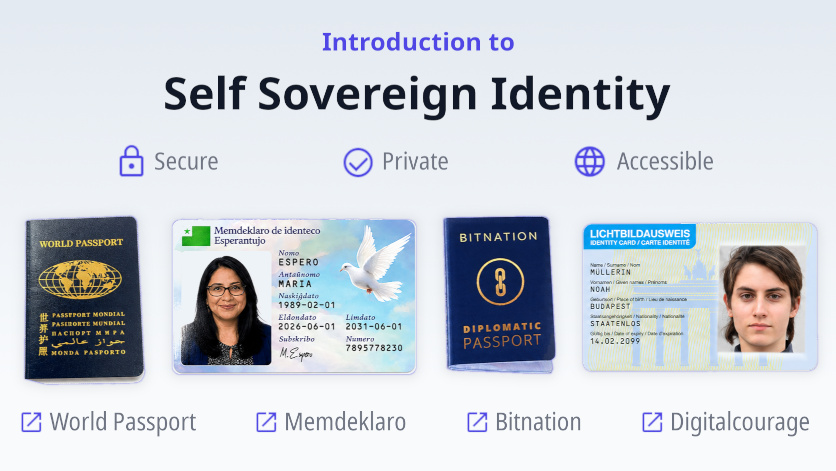
Non-government ID solutions can offer privacy, inclusion and freedom, when centralized ID systems fail. Here is a comparison between the Memdeklaro self-declaration, the Digitalcourage photo ID card and the World Citizen Passport.
By Memdeklaro | May 15, 2026
Introduction
In recent years, more and more services are requiring proof of identity - from jobs, banking and education, to housing, healthcare, contracts, sim cards, receiving mail and even visiting a library or joining a gym.
However, these new ID requirements can cause privacy concerns or accessibility issues, and even shut innocent people out of services that they have used for years.
The Hidden Problem of ID Requirements
While it may not be common knowledge, the reality is that government ID systems are not universally accessible. This goes beyond the cost of applications, long wait times, driving to government offices or searching for old paperwork.
Millions of people worldwide are unable to access government ID at all - no department or authority agrees to issue them a birth certificate, national ID card or passport.
In the majority of cases, this is not a punishment for a crime, but rather arises out of the person's circumstances of birth - for example, if they are stateless, a refugee or a dissident, if their parents never registered their birth, or if they escaped from severe child abuse or cult abuse.
You may assume that this would be a simple bureaucratic problem and that there would be a documented process to register this person and grant them a legal identity, such as via a delayed registration of birth or statelessness determination procedure.
However, it can be difficult or even impossible for people to access these procedures or for documentation to be granted - not due to the person's lack of action or refusal to cooperate, but due to the government not accepting applications, arbitrarily or discriminatorily declining applications without recourse or appeals, or not having a procedure to begin with.
As confirmed by human rights organizations like the United Nations, Red Cross and Amnesty International, lack of government ID is often not a personal failing, but rather an institutional problem. However, despite it not being the individual's fault, they are still personally punished for it, and in some cases, treated as criminals.
Imagine not being able to get a job, rent an apartment or even visit a doctor, just because abusive parents refused to register your birth, or if your country of birth refuses to recognize you as a citizen while simultaneously refusing to grant you stateless status or issue a non-citizen passport - and the even worse fact that there is nothing you can do about it.
The History of ID Requirements
Reputation: Good Enough for Most of Human History
In the past, trust used to be based on reputation and word of mouth. Passwords and keys were used for authorization and identity was often established through self-declaration, such as saying your name, filling out a form or providing your signature.
For situations where increased trust was required, vouches from trusted community members, cash deposits or escrows could be used.
The local church may have registered births, deaths and marriages, and there may have been an occasional census, but you did not require a signed certificate from the King in order to participate in everyday life.
Hard work and a good attitude was often enough to earn a good life, and the underdog stories of people who overcame adversity and achieved success were celebrated.
In short, the system was meritocratic and accessible, and you were judged based on your actions and efforts, rather than if you had permission from a centralized third party.
The 20th Century: The Birth of Surveillance Technology
After World War I, governments started implementing national identity cards and passports. These were generally used for international travel, and not required for daily life activities.
However, government ID systems quickly became a tool for control in authoritarian regimes. For people with access to ID, it became a way for the state to surveil and censor citizens in everyday life. For people without access, it was a way to totally exclude someone from the economy and society.
Many people attempted to flee these regimes, but encountered a horrifying obstacle - other nations would not let them in without an identity document, presumably issued from the very regime they escaped from.
As authoritarian regimes often used identity as a means of control and exclusion, defectors, dissidents and refugees often had no government-issued proof of identity, and their own declarations were not accepted.
This led to scenarios of innocent people being stuck at sea, as no country would take them in, or sent back to the regimes they escaped from, where they often met death or imprisonment. A cruel fate for people who simply wanted a safe place to start a new life.
Nansen Passports: An Alternative to Government ID
Fridtjof Nansen was shocked by this cruelty - peaceful people who wanted to work and contribute to society were being left for dead, purely due to a missing piece of paper. Alongside the League of Nations, he invented a laissez-passer document which was later named after him - the Nansen Passport.
The Nansen Passport was an identity document that did not need to be issued by a nation-state. It was available to everyone, including people fleeing authoritarian regimes which refused to issue them a passport.
And it worked. Hundreds of thousands of people were able to use the Nansen Passport to escape to safety, such as to the United States, United Kingdom or Western Europe.
Border officials, who had once refused entry, happily issued work visas to Nansen Passport holders, and people were able to build up a safe life for themselves. It was a simple paper booklet, but it made the difference between life and death.
The End of Nansen Passports: The End of Universal Access to Identity
The Nansen Passport was discontinued in the 1950s, replaced by the United Nations Conventions on Statelessness and Refugees. These conventions shifted the responsibility to issue identity documents back onto nation-states - returning to very problem that the Nansen Passports had solved.
The convention was not enough in practice to ensure legal identity for everyone. From the 1950s until today, nation-states continue to refuse to issue birth certificates, national ID cards and passports to millions of people, without appeals or alternatives.
The Nansen Passport had acted as an identity issuer of last resort. It was something that you could get if no one else would help you. After this last resort was closed down, there was nothing to replace it.
Garry Davis and the World Passport
In 1953, Garry Davis, a peace activist, founded the World Service Authority, which aimed to foster collaboration and understanding between people worldwide.
He started the World Citizen movement - a movement which did not discriminate based on birth place or birth culture, but rather united humanity as a whole.
Less than a decade after the horrors of World War II, and during the political tension of the Cold War, Davis made it his life goal to work toward world peace.
Part of his work at the World Service Authority was the issuance of World Passports, designed to support freedom of movement, provide an accessible identity document for dissidents, refugees and stateless people, and promote the idea of World Citizenship.
After renouncing United States citizenship, Davis himself used a World Passport to travel, and the World Passport gained de facto and de jure recognition from multiple countries worldwide.
From 1953 to 2026, over one million people have been issued a World Passport. The World Passport can be applied for online or by mail. Additionally, the World Service Authority has distributed World Passports for free to refugees and stateless people throughout the years.
The World Passport application process is designed to be inclusive - while the application asks for a copy of an existing government ID if available, it also allows applicants without an existing ID to submit fingerprints as an alternative.
This breaks the vicious circle and allows people to gain an initial proof of identity, even if no nation-state agrees to issue a passport for them.
Unfortunately while individual countries - including Ecuador, Mauritania, Tanzania and Zambia - formally recognized the World Passport in the 1950s, it is not commonly accepted by authorities today as a sole identity document, and it is categorized as a fantasy passport by authorities such as the European Union.
However, the World Passport is still unique in its humanitarian mission, has some case-by-case acceptance, and explicitly allows people who do not have an existing identity document to apply, making it a modern and practical solution for non-government ID.
Micronations: An Extension of the System, Not an Escape
In recent decades, many micronation projects have started up, often focused on staking a claim on unclaimed land, declaring a private property as a self-sovereign nation, or constructing a seastead in international waters.
Micronations offer an appealing alternative to the restrictions and barriers caused by modern nation-states. Micronations can offer competition in the fields of business, finance, law and institutions, and are often founded on an open-minded meritocratic culture, which could provide a welcome refuge for people escaping from authoritarianism.
Some micronations have been able to gain recognition from nation-states and other institutions. Two examples of successful micronations are Liberland, founded by Vit Jedlicka in 2015, and Prospera, founded by Erick Brimen in 2021.
Unfortunately, there is a danger to formal recognition - it can risk undermining the micronation's freedom and make the micronation dependent on the nation-state's regulations. Self-sovereign frontiers can become captured and new possibilities fade into existing structures.
A pertinent example being that both Prospera and Liberland now require an existing government-issued ID in order to apply for residency, or in Liberland's case, citizenship.
Micronations could have presented a hope for people locked out of the current system. If someone could apply for residency or citizenship without an existing national passport - perhaps going through an interview process, providing vouches or giving fingerprints as an alternative - that could give them a real way out of a bleak situation, and an accessible pathway to join society, work hard and make a difference.
In reality, micronations' government ID requirements perpetuate the same barriers as nation-states. If no nation-state is willing to issue a passport or birth certificate for you, even micronations cannot offer a last resort, neither for physical residency nor as a first citizenship.
Bitnation: Blockchain Identity for All
Bitnation was an ambitious blockchain-based project, founded by Susanne Tarkowski Tempelhof in 2014.
Bitnation was a framework for virtual micronations based on freedom of association, intentional communities and voluntary relationships, envisioning a Network State that could empower individual freedom across the world.
The Bitnation project explicitly supported communities of choice, believing that personal beliefs and actions matter more than circumstances of birth. They believed that everyone should have a chance to build a good life in a community of their choice, rather than be permanently confined to the culture they were born in.
Bitnation offered an all-in-one framework for voluntary communities, governance, contracts, finances and identity. But that's not all.
One of the project's major achievements was the Bitnation Diplomatic Passport, a physical passport booklet available to anyone regardless of nationality or status.
To apply for a Bitnation Diplomatic Passport, you simply needed to pay a fee and have an interview with a Bitnation ambassador. No existing government ID was required, which made it accessible as a foundational identity document. The project also distributed free Bitnation identity documents to refugees and stateless people.
Unfortunately, Bitnation shut down operations in the early 2020s.
Bitnation made a mark on the world as a pioneer in blockchain identity and voluntary communities. Perhaps a new blockchain project will pick up the torch in the future and continue Bitnation's vision for a freer world.
Digitalcourage Lichtbildausweis: A Modern Solution
Digitalcourage was founded in 1987 by Rena Tangens and Padeluun to advocate for human rights, particularly the fundamental right to a private life.
Throughout the years, Digitalcourage has succeeded in defending against privacy-invading practices by corporations and legislators, as well as educating people on how they can effectively protect their privacy, defend themselves against surveillance and live freely.
Noting the sudden increase in companies demanding proof of identity, even for services that the companies had been successfully offering without ID for decades, the Digitalcourage team recognized the potential implications for privacy and surveillance, and started to design a solution.
The situation was concerning: Services that people had used for years without problems became inaccessible overnight - banned not due to bad behavior, but due to an insurmountable bureaucratic hurdle. Access to necessary services was taken away arbitrarily without replacement. The vicious circle remained: ID was required for access, but no authority agreed to issue an ID.
In 2013, Digitalcourage launched their solution. The Digitalcourage ID looks like a standard ID card, with a photo, name, birth date and other details. It is advertised as a non-government ID card, which may be used for purposes that do not legally require a government-issued document.
The Digitalcourage ID is available to everyone and the application does not require an existing government ID. The non-profit openly allows use of a self-chosen name and explicitly allows stateless people to apply.
Unlike a passport, the Digitalcourage ID is not intended for travel. Rather, it is intended to be used in daily life situations where a company may ask for proof of identity, such as a post office, apartment rental, library or gym.
The non-profit deliberately makes a distinction between cases where a government-issued ID may be legally required, such as when crossing a border or opening a bank account, and situations where the law does not require government-issued identification, but rather the company's own terms may stipulate that customers should be reasonably identified. The latter may include PO boxes, rental contracts, memberships or personalized tickets.
It is not guaranteed that private companies will accept the Digitalcourage ID as proof of identity. However, anecodally people have had success in using their Digitalcourage ID in everyday life.
Although the best option would be to return to the days where these services did not demand ID, non-govenment IDs can give people a way back into society and a way to continue to access the services they need. Today, the Digitalcourage ID offers a genuine and working alternative to the state's monopoly on identity.
Memdeklaro: Ethical Self-Declaration of Identity
The Memdeklaro project began in 2024 as a public domain initiative.
The focus of the project is Memdeklaro de identeco - a self-declaration of identity, which can take the form of a plastic card, business card or digital ID.
The unique part about Memdeklaro is that it is self-asserted and self-printed by the individual - there is no central issuer, no registry, and no third parties.
Following the philosophy of freedom of identity, Memdeklaro supports people in choosing their own name, culture and personal ties, instead of being permanently confined to their circumstances of birth. In addition, the Memdeklaro ID explicitly does not include the holder's birth place, citizenship or stateless status, or birth parents' names. There is a notes field to optionally express personal beliefs, such as being a conscientious objector.
People can generate a self-declaration for free using the Memdeklaro web app. The web app is built with privacy in mind: it runs locally on your device, and no data is sent to a server or recorded in a database. After generating a self-declaration, users can print it themselves as a plastic card or business card or use it digitally.
The public domain dedication means that anyone can fork the project and create their own implementations, ideas and alternatives.
While the project is relatively new, hopefully the idea of self-declaration of identity could catch on and become more mainstream as time goes on.
What Solutions Exist Today
The World Passport, Digitalcourage ID and Memdeklaro remain as practical non-government ID solutions that are available to use today.
All three are good options. They all do not require an existing government ID, they all allow stateless applicants, and they all have an ethical humanitarian mission. What differs is the format - passport booklet vs. plastic ID card, the design, and the data recorded on the ID, as well as specific details such as the cost, processing time and application process.
Below is a comparison table, which summarizes each option.
Comparison Table
| Feature | Memdeklaro | Digitalcourage Lichtbildausweis | World Passport | Bitnation Diplomatic Passport |
|---|---|---|---|---|
| Basic concept | Self-declaration of identity | Privacy-friendly ID | World citizenship passport | Blockchain ID |
| Year of launch | 2024 | 2013 | 1954 | 2018 |
| Issuer | Self-asserted | Digitalcourage e.V. | World Service Authority | Bitnation |
| Cost | Free | €15 | $75 | $149 |
| Processing time | Instant | 10 days | 4 months | Discontinued |
| Format | Physical or digital ID card | Physical ID card | Passport booklet | Passport booklet |
| Data included | First name, last name, photo, birth date, signature, notes field | First name, last name, photo, birth date, birth place, citizenship or stateless status, eye color, height, home address, pseudonym | First name, last name, photo, birth date, birth place | Unknown |
| Data excluded | Birth place, citizenship or stateless status, parents' names | N/A | Citizenship or stateless status | N/A |
| Requires an existing government ID | No | No | No; requires fingerprints | No; requires interview |
| Centralized database | No data is stored | Data deleted after 10 days | Stored in issuer's database | ID number stored on blockchain |
| Summary | Open source self-declaration that lets individuals generate their own non-government identity document | Privacy-friendly non-government photo ID that allows users to decide which information appears on the card | World citizenship passport supporting the universal right to freedom of movement | Diplomatic passport supporting voluntary communities and blockchain-based micronations |
Conclusion
Identity has not always required government approval.
Back in the day, people relied on self-declaration and word-of-mouth reputation. The local church may have recorded births, deaths and marriages, but you did not need a signed certificate from the King in order to live your everyday life.
After World War I, nation-states introduced national passports and identity cards, but it was soon clear that identity could be used as a tool of oppression. The Nansen Passport was invented as an alternative, and it helped hundreds of thousands of people to flee oppressive regimes and start a new life. However, Nansen Passports were discontinued in the 1950s without replacement.
Since then, there have been various initiatives for non-government identity documents, such as the World Passport by Garry Davis, the Bitnation Diplomatic Passport by Susanne Tarkowski Tempelhof, the Digitalcourage ID by Rena Tangens and Padeluun, and the Memdeklaro self-declaration by the Memdeklaro public domain project.
As more and more necessities start to require ID, while nation-states continue to refuse to print IDs for millions of people, an accessible alternative is urgently required.
While acceptance may not be universal, non-government ID providers offer a vital alternative to the state monopoly on identity, which will hopefully continue to provide access and inclusion to people in need.
See also: The Basics of Decentralized Identity (DID) and Self-Sovereign Identity (SSI)